Dyno Runs

The place to "speak geek"
Post Reply
User avatar
r10crw
Posts: 1966
Joined: Thu Aug 10, 2006 8:14 pm
Location: Aberdeenshire

Dyno Runs

Post by r10crw » Fri Aug 22, 2008 9:07 am

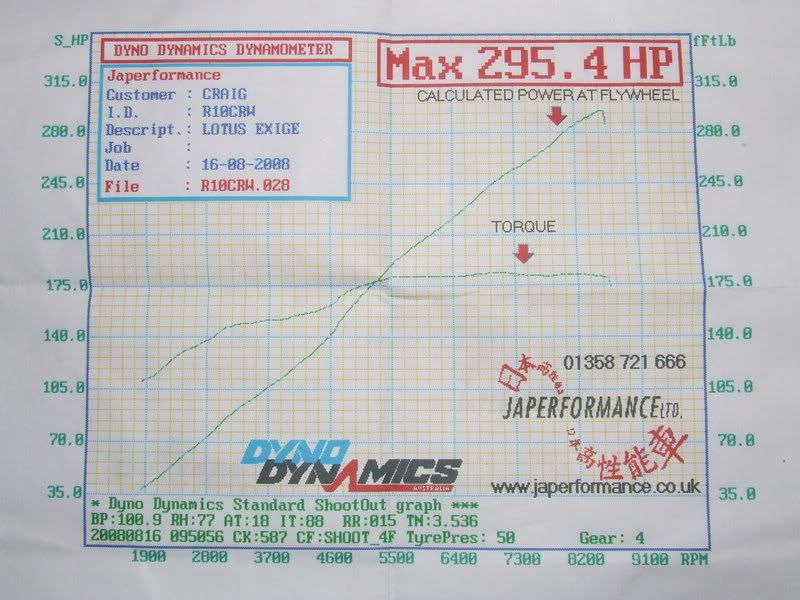
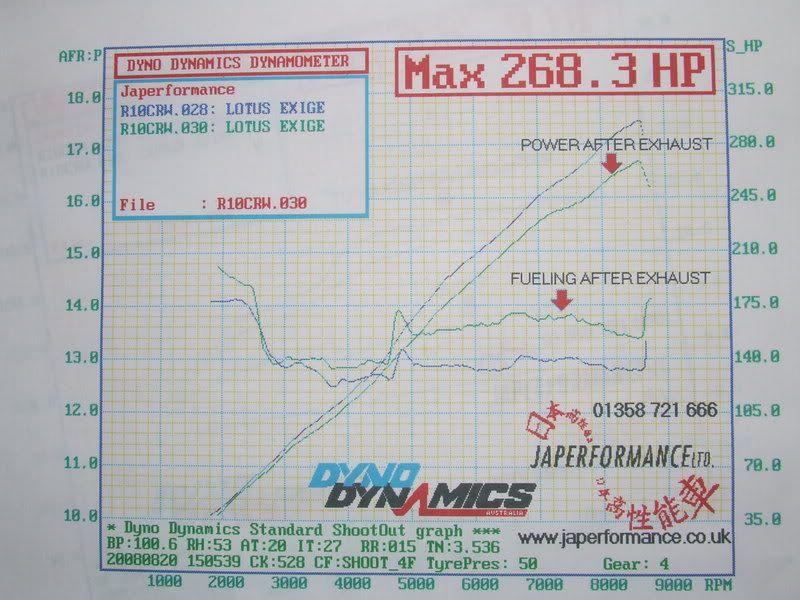
As explained in the other thread my car lost around 25 hp with a new exhaust. Now whilst I believe it lost power and is running lean Im still not sure about the runs. Hoping that some of the gurus on here could have a look at the two runs on different days, I dont know what the figures at the bottom mean and why some are different. Thing is I just cant understand losing this much from a manifold and backbox and wouldnt put it past them being manipulated in order to sell me a standalone ecu! Any opinions very much appreciated.
Image
Image
Hairdresser at heart.

User avatar
Rich H
Posts: 9314
Joined: Sun Jul 31, 2005 10:11 pm
Location: Preston

Re: Dyno Runs

Post by Rich H » Fri Aug 22, 2008 9:19 am

Do you have a torque curve for the after run?

This is pure guess work however:

Could the cam overlap blow part of the induction charge straight through and out the exhaust?
If the new exahust is better flowing it will have a lower back pressure for the supercharger to blow against, so during overlap the inlet charge is pressureised but the exhaust is not, pressure differential blows the nice fresh charge straight out the exhaust reducing the amount of fresh charge to burn = lower power??

Essentially it is lowering your CR. Fixes would be less overlap perhaps? Doubt an ECU will fix this, what will it do? Throw in more fuel to be blown out the exhaust again?

As I said pure speculation though...
1994 Lotus Esprit S4 - Work in progress
1980 Porsche 924 Turbo - Funky Interior Spec
2004 Smart Roadster Coupe - Hers

User avatar
hiscot
Posts: 757
Joined: Mon May 08, 2006 8:56 am
Location: North Scotland

Re: Dyno Runs

Post by hiscot » Fri Aug 22, 2008 6:49 pm

imo stand alone results are pointless a guestamate figure only great for setting up cars or compairing yours with mine on the same day
i would always rather see both figures ( fly and wheel ) as i have found this calculation from wheel power is not too far off
http://www.pumaracing.co.uk/coastdwn.htm
bob

Light travels faster than sound. This is why some people appear bright until you hear them speak

User avatar
robin
Jedi Master
Posts: 10546
Joined: Mon Mar 27, 2006 1:39 pm

Re: Dyno Runs

Post by robin » Fri Aug 22, 2008 9:07 pm

BP = Barometric Pressure - engine fills relative to atmospheric pressure, but as your's is pressurised and the difference is minor, you can safely ignore this.
RH = Relative Humidity - it was wetter on the second run! Extra water in the air is a mixed blessing as it helps keep the charge cool, though obviously the water vapour takes up space that could be occupied by Oxygen. However, I doubt it makes much difference.
AT = Air Temperature - higher temperatures thin the charge, but remember that the effect is relative to absolute 0 (-273) so you're comparing 291 vs 293, so near as damn it the same.

IT = I would have thought inlet temperature, but I cannot believe 88 vs 17, so not sure what to make of that - perhaps they wired something up last time that they didn't wire up this time? Certainly 88 would be bad and 17 would be good, so that wouldn't explain the difference.

RR/TN I would guess these are to do with the RPM-to-Roadspeed configuration for the car. Anyway, they're the same so shouldn't matter.

Rich: the torque curve will scale exactly the same way that the power curve has = RPM is the same on both curves; Power = Torque * RPM/5250 - you could draw it in if you like.

So the comparison between torque curves will yield just exactly the same thing as comparing the power curves.

The fact that the exhaust gas is now leaner than it was implies that the engine is flowing more air and the ECU hasn't compensated for it, rather than say differences in rolling road measurements (which would result in the same AFR in both cases).

The fact that the power has dropped could simply be down to the fact that the mapping is now out. It's lean, so not enough fuel = faster burn = ignition too advanced; you reach peak pressure in the cylinder before the magic ~10-20 degrees ATDC and thus generate less torque (==less power).

I assume the cam changeover is at 4,750-ish, hence the spike in AFR?

Either put the old exhaust back on or get it remapped - there's a guy who's name is something like CharlieX IIRC on the US forums that can remap the later T4 ECUs like yours ... not saying it's cheap but better than hacking up the looms, no?

Alternately you could increase the fuelling a tad by fitting a secondary pressure regulator - this would possibly return the AFR to something saner (13 or less is ideal at full throttle/high RPM) - it would also slow down the burn and hopefully result in better power generation by retiming peak pressure to the correct point. But I don't know what these T4 ECUs do when you start messing with the engines ... people say that the ECU fights any attempt to make the engine produce more power ... maybe only on the normal cars, not the cups ... or maybe just internet folklore anyway?

Cheers,
Robin
I is in your loomz nibblin ur wirez
#bemoretut

User avatar
r10crw
Posts: 1966
Joined: Thu Aug 10, 2006 8:14 pm
Location: Aberdeenshire

Re: Dyno Runs

Post by r10crw » Sun Aug 24, 2008 11:40 am

As usual robin brilliant reply, so I can pretty much rule out the operator. I can explain the intake temps, the temps are before and after charge cooler to see how much difference it made so pretty pleased with that.
Nice that you think the loss is due to the tune but still wondering if it could all be brought back. Charliex is Charlie wallace, scottish programmer moved to LV as a kid and is responsable for the map in the ecu just now, trouble is he is so busy in the states he wants sincs to take care of everything in the uk.
Ive sorta gotta solution, we reckon a drop of 1 AFR equates to 5% increase in the injector duration so the ecu is away being flashed with this across the board and Ill try it again. Ive got my own wide band and jim fitted a bung for me so just gotta install it and monitor it, save dyno runs each time. Trouble with this is even if the car makes great power part load operations might be all over the place, just got to wait and see.
"I assume the cam changeover is at 4,750-ish, hence the spike in AFR?" quite right full load change over at 4750, still has you looking for a moment. Thanks Craig.
Hairdresser at heart.

Post Reply