Page 1 of 1
Toe Links
Posted: Thu Apr 28, 2011 9:58 pm
by steviej
Over the last few weeks I have been making some uprated toe links, purchased all the rod ends, spacers and boots,
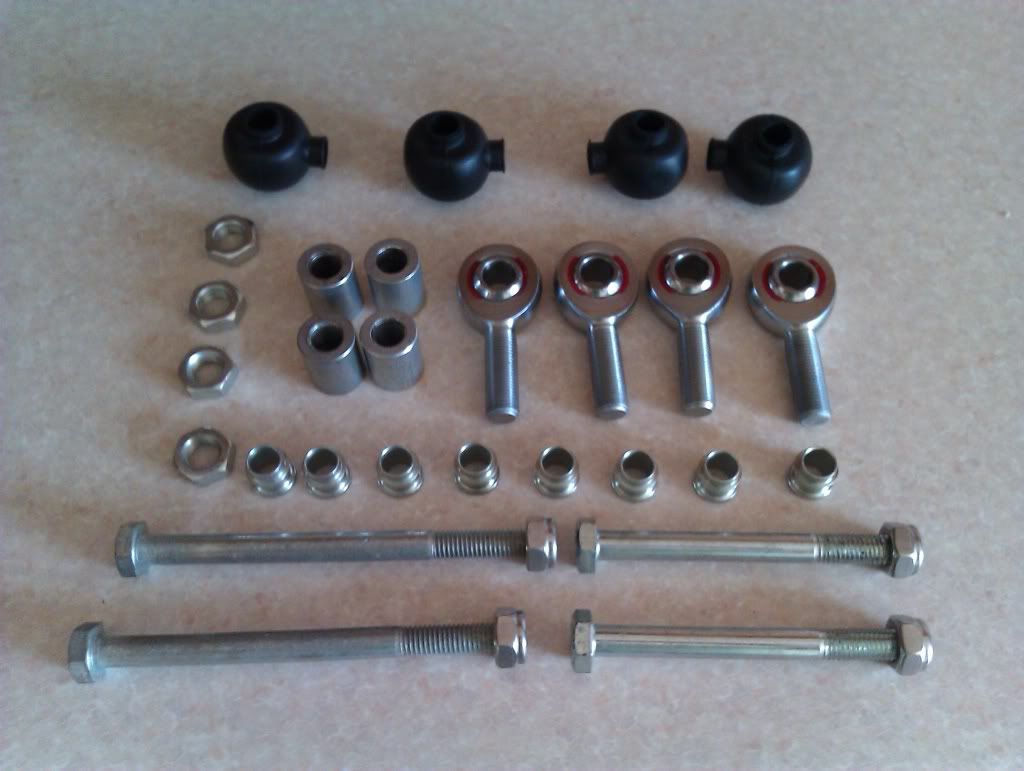
Made up the link bars and fitted the ends and misalignment spacers
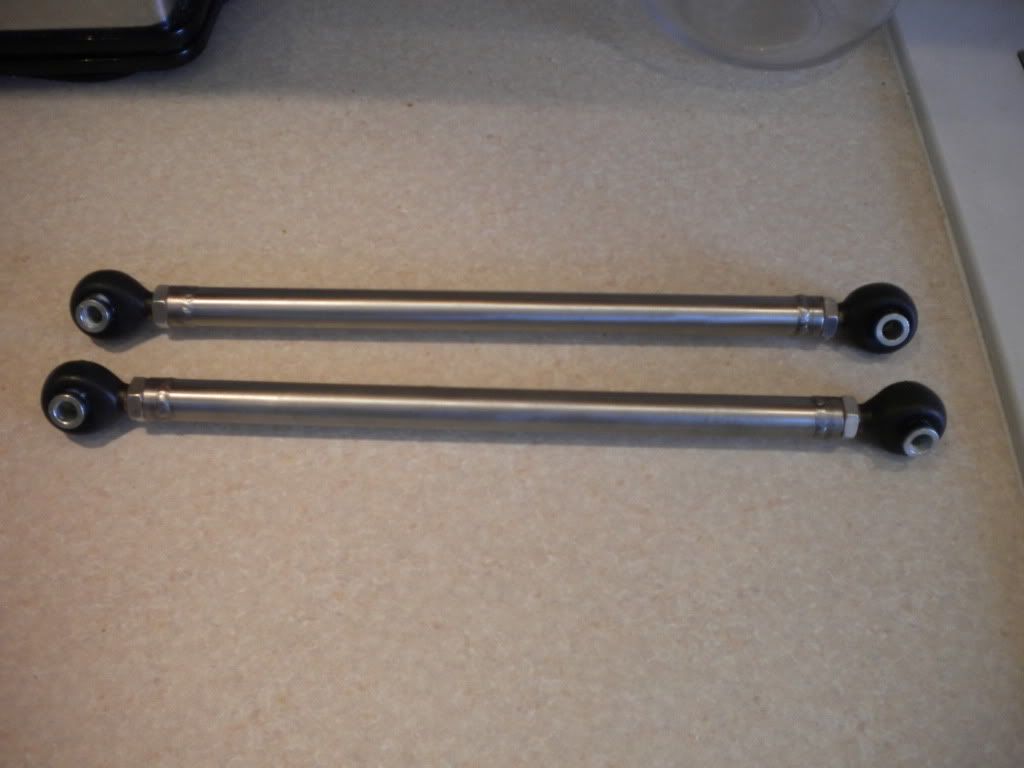
Fitted them today and reset front and rear toe
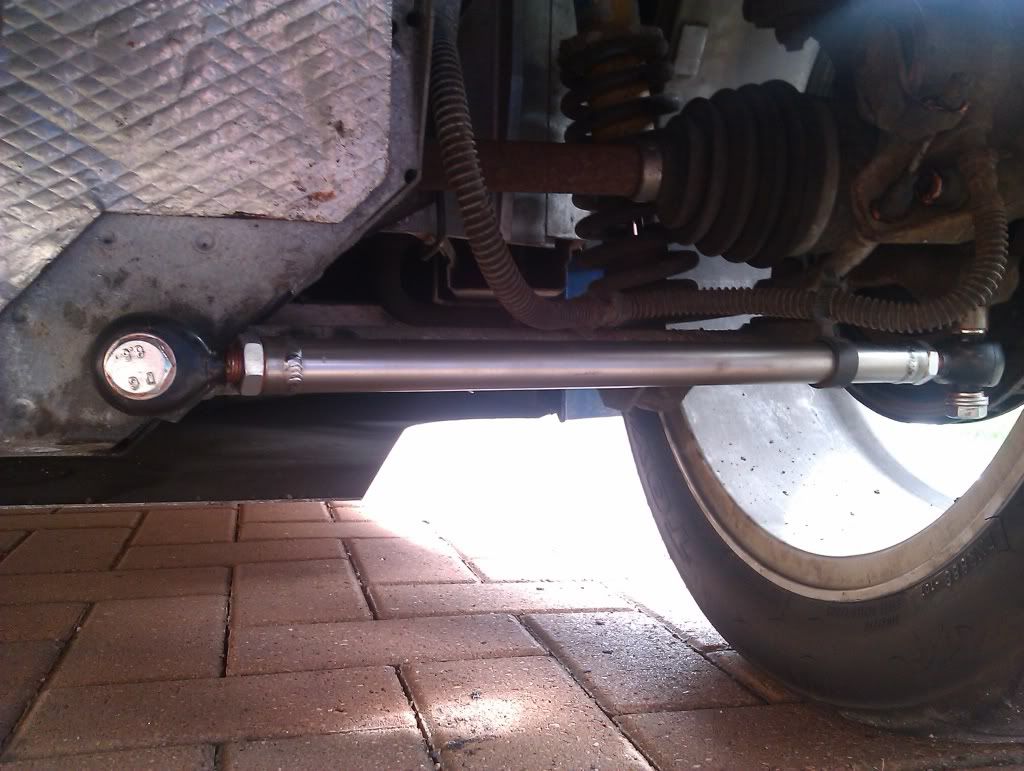
All in cost around half the price of buying an off the shelf kit.
Reset the front camber and front / rear toe and car feels really good, over the long weekend Im going up to Grantown and Aviemore then over to Fort William, Fort Augustus and home via Loch Ness, should be a decent trial run for it.
Stevie
Re: Toe Links
Posted: Thu Apr 28, 2011 10:12 pm
by roadboy
steviej wrote:
All in cost around half the price of buying an off the shelf kit.
Not really comparing apples with apples though, are you?
Firstly, you haven't got the inner joints mounted in double shear so there's no real advantage over the standard setup.
Also, what brand of rod ends did you use? If you really did it for ~£100 (half the price of the Elise shop stainless kit) I would suggest that the rod ends you've used won't last two minutes. A set of four decent rod ends will easily cost you more than 100 quid.
/2p
Dan
Re: Toe Links
Posted: Thu Apr 28, 2011 10:34 pm
by robin
Considering the outboard end is always in single shear (ignoring early S1's with alloy uprights), I'm not sure that it matters that the inboard end is in single shear? I've seen a few of these break (in real time on more than one occasion

) and I've only seen the outboard end break. I have seen the inboard end damage the subframe when it hasn't been tightened properly, but even then it didn't break the bolt (though I'm sure it would eventually if left unchecked).
Cheers,
Robin
Re: Toe Links
Posted: Thu Apr 28, 2011 10:46 pm
by roadboy
Can't agree with that Robin. The way the outboard joint is mounted is very different so there is no need to have that in double shear. The same can't be said for the inboard joint.
I have seen inboard joints break as well as outboard joints and I've seen the rods snap too.
Dan
Re: Toe Links
Posted: Thu Apr 28, 2011 11:32 pm
by steviej
I have measured for the inboard double shear brackets and intend to make and fit them before using on track.
Re: Toe Links
Posted: Thu Apr 28, 2011 11:42 pm
by Stu160
roadboy wrote:Can't agree with that Robin. The way the outboard joint is mounted is very different so there is no need to have that in double shear. The same can't be said for the inboard joint.
I have seen inboard joints break as well as outboard joints and I've seen the rods snap too.
Dan
Both are a rod ends mounted with a bolt, so how are they mounted differently?
Just asking out of interest, also , how does the flimsey little sheet metal plate held in place with a few m5 cap screws acually class as double shear? I am not sure if that would be rigid enough to help anything thing.
Stu
Re: Toe Links
Posted: Thu Apr 28, 2011 11:51 pm
by Gourlay83
Good effort, an improvement over the standard (rubber) toe links.
A good improvement would be to link the outer toe link (outer face) to the other side or even better a mount in the middle of the brace bar, so loads get transferred into the subframe. That would give you your two shear planes as mentioned above.
I do see where Robin's coming from, you have a force and a cross sectional area. You would have to have both joints in double shear for the system to be stronger.
Where/how do the joints normally fail ?
Alan
Re: Toe Links
Posted: Fri Apr 29, 2011 12:00 am
by mckeann
every one i have had or seen has been the outer bolt. Very occasionally seen the actual toe link bar snap, but i'm not sure if that was a crash or kerb that caused it.
I agree with Stu that the flimsy little cover is barely strong enough to be double shear.
Re: Toe Links
Posted: Fri Apr 29, 2011 12:02 am
by Stu160
Hi Alan
Best way to put the inner joint in double shear is to make a link bar between the two inner joints, also reduces flex in the subframe.
Only toe links i have seen fail have been old , worn out ones, and ones that have had impact in some shape or form. That could be hitting a wall, or hitting a kerb on track to hard/ often. However , i am sure there will be other other people out there with a different opinion to mine

And , good effort Stevie
Stu
Re: Toe Links
Posted: Fri Apr 29, 2011 8:48 am
by BiggestNizzy
I like the idea of making my own could you list the parts and sizes, I'm lazy and can't be bothered measuring it myself

Re: Toe Links
Posted: Fri Apr 29, 2011 8:52 am
by Ferg
Stu160 wrote:Best way to put the inner joint in double shear is to make a link bar between the two inner joints, also reduces flex in the subframe.
I've seen that before, but not seen it as part of any kits out there. Is it purely a custom option?
Re: Toe Links
Posted: Fri Apr 29, 2011 9:13 am
by steviej
A link bar between the inners would be a better idea, just another two rod ends and a length of tube, and much easier to make than the two brackets, and drilling the subframe to fit them.
Thats this months 'project for work' sorted then
Re: Toe Links
Posted: Fri Apr 29, 2011 9:30 am
by robin
The brace bar is fitted as standard to some of the S2 Exige variants. I don't understand enough about mechanics to know whether or not this actually provides double shear, though. In cornering situations, if one link is in compression the other is either under no load or it's in tension, so both bolts are under parallel loads anyway, and thus the brace bar may be under no load at all. Of course if both bars are in compression or both bars are in tension then the brace bar will provide the double shear effect.
Cheers,
Robin
Re: Toe Links
Posted: Fri Apr 29, 2011 4:44 pm
by alicrozier
One of the variations Robin was to have the bace bar also bolted to the subframe, see #39.
http://www.deroure.com/diagrams.asp?TBL ... 6014S&SC=1
Not seperately attaching the brace bar is just sharing the bending load between each side. I'm also not sure how each individual toelink is loaded into a corner though hence if it provides any double shear support. I agree with Stu the bracket versions may not be stiff enough (slightly different thing to strong enough Ape, in order to take a load the bracket load path must be stiffer than the bolt in bending).
One thing that might be interesting is imagine parts #42 and #43 combined as one machined component. Definitely stiff enough and double shear...
Then of course there are double shear outboard hub solutions:
http://www.eliseparts.com/products/show ... rear-pair/