engine head phones
engine head phones
Anyone in the north got headphones I can use for listening to my engine. Put a write up on seloc about whats happening, corbie will probably come on and give a better explanation but basically im getting knock at various parts within the rev range and need to determine if its genuine knock or noise from my stiff engine mounts. Strange thing is if I blip the throttle at standstill up to 6 thou or so im getting counts so that sort of rules out drivetrain noise. Also should the noise threshold change from a n/a to s/c engine. I would have thought the knock threshold must be derived from engine specifics in which case mines not accurate.

The engine has a knock sensor built in, right?
And the aftermarket ECU is telling you that you're getting knock events because it's seeing a signal from that knock sensor?
If the ECU has calibration for the knock sensor you could play with it, but TBH I'll bet no change is required. The knock sensor is a microphone to all intents and purposes and the ECU is looking for a signal from it leading up to TDC - if it gets a noise burst too far before TDC it assumes that pre-ignition has occurred and I would hope it would do something to the ignition timing if this keeps happening.
What I think you do need (and I assume you have done it already) is to retard the ignition compared to a N/A engine (the higher the chamber pressure, the faster the flame advances through the mixture, so less advance is required).
Can you hear it tinkling away when you're getting counts - it's usually pretty obvious, but I understand that your car is mentally loud with the S/C, so maybe you cannot hear it.
I know that DASTEK have the cans that they wear whilst mapping so that they can hear the knocking when it happens; I doubt they calibrate them on a vehicle-by-vehicle basis, so I would assume they work for any car.
Cheers,
Robin
And the aftermarket ECU is telling you that you're getting knock events because it's seeing a signal from that knock sensor?
If the ECU has calibration for the knock sensor you could play with it, but TBH I'll bet no change is required. The knock sensor is a microphone to all intents and purposes and the ECU is looking for a signal from it leading up to TDC - if it gets a noise burst too far before TDC it assumes that pre-ignition has occurred and I would hope it would do something to the ignition timing if this keeps happening.
What I think you do need (and I assume you have done it already) is to retard the ignition compared to a N/A engine (the higher the chamber pressure, the faster the flame advances through the mixture, so less advance is required).
Can you hear it tinkling away when you're getting counts - it's usually pretty obvious, but I understand that your car is mentally loud with the S/C, so maybe you cannot hear it.
I know that DASTEK have the cans that they wear whilst mapping so that they can hear the knocking when it happens; I doubt they calibrate them on a vehicle-by-vehicle basis, so I would assume they work for any car.
Cheers,
Robin
I is in your loomz nibblin ur wirez
#bemoretut
#bemoretut
The ecu does read the knock but it only classes it as knock if it exceeds a value which it decides to be knock. Its really just calculating a SNR but Idont know if its genuine preignition noise or drivetrain noise from engine mounts. Tried retarding the ignition and it made it worse and advancing it made it slightly better. Robin your entirly right, the only thing you hear with the engine running is the supercharger, since upping the boost its a little crazy.
Hmm.
Done some reading on Knock sensors. It does seem as though there are two types (or at least the ECUs behave differently). In one case, any significant output from the sensor is classed as a knock, irrespective of engine phase. In the other case they are analysed with respect to engine phase and knock indication only occurs when there is a signal from the knock sensor in the relevant time window.
In your case I suspect you have the former type, simply because (a) there is just one sensor and (b) there would be more parameters on your ECU tuning laptop if there was a timing window to be applied.
I think that the knock sensors are microphones, but they are tuned resonant circuits - i.e. they are sensitive to sound energy in a particular frequency range and are thus tuned for your block and manifolds, mostly. If you change the manifolds or add a substantial source of new sound energy (pictures of nutter barsteward whirling compressors spring to mind) then you may confuse them. They are also quite sensitive to installation torque and jointing compounds - have you removed and refitted yours?
I saw your post on SELOC:
I think you should patch a scope into the knock sensor output and see how it's running.
First off with the engine stopped but the ignition on - look for noise on the signal.
Next using a slow time base (500ms/div, say) and a soft-faced hammer, tap the block and watch the sensor output. Using a slow timebase like 500ms/div makes sure you see the whole knock event, not just the foothills as it were. Look for the peak voltage, then you can set the trigger voltage somewhere like 2/3 of peak and use a faster timebase to look at the signal in more detail - I would be interested to see if it's a single continuous signal or a modulated sine wave type of signal).
Now run the engine and see what the output from the sensor looks like at idle, then slowly build the revs and see what the sensor output looks like; again you might need to mess with time base and trigger levels to make sure you see the real data and not just some noise.
If you see that the output rises and falls significantly throughout the rev range you have a harmonic of some sort setting off the sensor.
You should compare the peaks under running with what you got from the whack-it test. If you've get signals close to the whack-it result from no-load revving then you're going to need to alter the knock sensor in some way.
Cheers,
Robin
Done some reading on Knock sensors. It does seem as though there are two types (or at least the ECUs behave differently). In one case, any significant output from the sensor is classed as a knock, irrespective of engine phase. In the other case they are analysed with respect to engine phase and knock indication only occurs when there is a signal from the knock sensor in the relevant time window.
In your case I suspect you have the former type, simply because (a) there is just one sensor and (b) there would be more parameters on your ECU tuning laptop if there was a timing window to be applied.
I think that the knock sensors are microphones, but they are tuned resonant circuits - i.e. they are sensitive to sound energy in a particular frequency range and are thus tuned for your block and manifolds, mostly. If you change the manifolds or add a substantial source of new sound energy (pictures of nutter barsteward whirling compressors spring to mind) then you may confuse them. They are also quite sensitive to installation torque and jointing compounds - have you removed and refitted yours?
I saw your post on SELOC:
Care to describe the peaks on the graph? i.e. at what RPMs do they occur. If they are harmonics of one another then an accidental resonance is likely to be your problem. You could also screen shot the graph (In case you don't know how: alt-PrintScreen, then start->run..., mspaint<enter>, then ctrl-v to paste in the bitmap of your screen - you can either save that as a jpeg and email it, or crop it first to make it a bit less cumbersome).Think thats probably the best bet, when looking at the handata graphs there are very distinct peaks but only around four throughout the rev range ( 4 that actually exceed the knock threshold) as opposed to the actual count of 19.
I think you should patch a scope into the knock sensor output and see how it's running.
First off with the engine stopped but the ignition on - look for noise on the signal.
Next using a slow time base (500ms/div, say) and a soft-faced hammer, tap the block and watch the sensor output. Using a slow timebase like 500ms/div makes sure you see the whole knock event, not just the foothills as it were. Look for the peak voltage, then you can set the trigger voltage somewhere like 2/3 of peak and use a faster timebase to look at the signal in more detail - I would be interested to see if it's a single continuous signal or a modulated sine wave type of signal).
Now run the engine and see what the output from the sensor looks like at idle, then slowly build the revs and see what the sensor output looks like; again you might need to mess with time base and trigger levels to make sure you see the real data and not just some noise.
If you see that the output rises and falls significantly throughout the rev range you have a harmonic of some sort setting off the sensor.
You should compare the peaks under running with what you got from the whack-it test. If you've get signals close to the whack-it result from no-load revving then you're going to need to alter the knock sensor in some way.
Cheers,
Robin
I is in your loomz nibblin ur wirez
#bemoretut
#bemoretut
I never knew you could do that , everyday is a school day : 
You could also screen shot the graph (In case you don't know how: alt-PrintScreen, then start->run..., mspaint<enter>, then ctrl-v to paste in the bitmap of your screen - you can either save that as a jpeg and email it, or crop it first to make it a bit less cumbersome).
You could also screen shot the graph (In case you don't know how: alt-PrintScreen, then start->run..., mspaint<enter>, then ctrl-v to paste in the bitmap of your screen - you can either save that as a jpeg and email it, or crop it first to make it a bit less cumbersome).
No lotus
Exige Sport 350 (Sold)
Elise Cup 250 (Air con and radio tubby spec) (Sold)
Evora S (sold)
Exige Sport 350 (Sold)
Elise Cup 250 (Air con and radio tubby spec) (Sold)
Evora S (sold)

Or not ... not sure I learnt anything much at UMIST (except perhaps how to pass a degree course in minimum effort, and also I didn't know what a barm cake was before I went there http://en.wikipedia.org/wiki/Barm)campbell wrote:Exactly what I was about to say Robin. Saved me the trouble
[crikey!! UMIST was good for summat eh]
Anyway, the real question is whether any of it is right - I made most of it up

Robin
I is in your loomz nibblin ur wirez
#bemoretut
#bemoretut

UMIST was great, I spent 3 years getting drunk, sleeping in random places and spending other peoples money then they gave me a degree!
It was a third but thats what you get for being drunk for 3 years...
It was a third but thats what you get for being drunk for 3 years...
1994 Lotus Esprit S4 - Work in progress
1980 Porsche 924 Turbo - Funky Interior Spec
2004 Smart Roadster Coupe - Hers
1980 Porsche 924 Turbo - Funky Interior Spec
2004 Smart Roadster Coupe - Hers
Weve made some progress, kncok was ocurring at around 3-4k and 6.5-7.5k. Turns out the lower end might be because the low cam struggles to flow enough gases from a high boost engine. A lot of people have had similar and by lowering the vtec entry to 3k can remove this, still leaves me with the high end. Have a look at this graph and see what you think, it shows the knock count but also shows the signal from the senosr and the threshold which defines knock. Very possibly noise on the line giving an acuumulative effect. Not so sure about the harmonics, the second someone mentions harmonics I have nightmares about fast fourier transforms. I dont have a scope but might try using the ecu log to diagnose with the engine off. See what you think in the mean time.
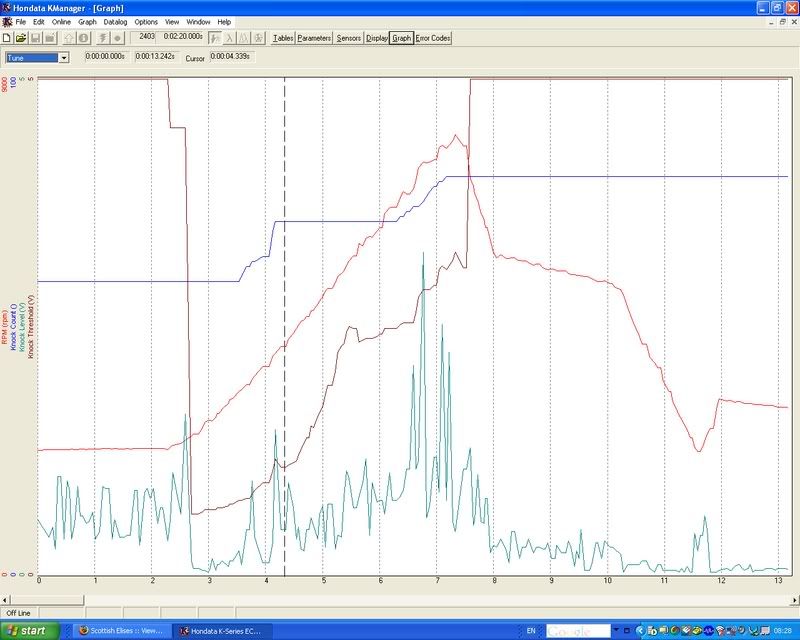

The sampling rate on this is much too low to tell what is happening I am afraid.
However, I can make some observations that might help:
Just to check I understand what I am looking at, this is an in gear run, starting at a steady ~2000RPM, running up to 8000RPM and then braking/coasting back down again?
The knock output during the first 2.5s (steady throttle) is probably chatter from the gearbox rattling in and out of backlash? The reason I think this is that there is almost no noise at the other end of the chart going through the same rev range until you shift down a gear, and then it goes quiet again once the clutch is fully engaged.
There are then 7 spikes:
2,500 rpm, this very shortly after you opened the throttle.
3,500 rpm
4,000 rpm
7,000 rpm
7,500 rpm
7,750 rpm
7,850 rpm
If spike #1 is transmission noise (see above) then the rest *could* fit with a resonance at 3,500 and 4,000 rpm plus harmonic at 7,000 and 8,000 rpm.
Essentially spike #2 is at half the frequency of the spike #4 and #5 and the spike #3 is at half the frequency of #6 and #7.
We need to see it at higher resolution to be sure though as with the sampling set up the way it is we have no real idea of what we're seeing.
Nyquist's theorem tells us that to see a 100Hz signal we must sample at least at 200Hz; at 8,000 rpm your engine is spinning at 133Hz so we really need to sample at least at 266Hz to see blow-by-blow events and I would think sampling at 1KHz would be called for to really see anything much. Of course the data can then be averaged so that you can plot it on a timescale like that above, and if that's what has happened here, fair enough.
If you can persuade it to sample and log faster then plot on a higher resolution timebase, it would be very interesting to see a slow sweep from 2,000 to 4,000 rpm in neutral.
It's tedious but one way of doing this would be to hold it steady in 100 rpm increments, start/stop capture on the laptop, then plot and snapshot the chart plotted on say 0.1s increments on the x-axis. Repeat for each 100 rpm increment.
Cheers,
Robin
However, I can make some observations that might help:
Just to check I understand what I am looking at, this is an in gear run, starting at a steady ~2000RPM, running up to 8000RPM and then braking/coasting back down again?
The knock output during the first 2.5s (steady throttle) is probably chatter from the gearbox rattling in and out of backlash? The reason I think this is that there is almost no noise at the other end of the chart going through the same rev range until you shift down a gear, and then it goes quiet again once the clutch is fully engaged.
There are then 7 spikes:
2,500 rpm, this very shortly after you opened the throttle.
3,500 rpm
4,000 rpm
7,000 rpm
7,500 rpm
7,750 rpm
7,850 rpm
If spike #1 is transmission noise (see above) then the rest *could* fit with a resonance at 3,500 and 4,000 rpm plus harmonic at 7,000 and 8,000 rpm.
Essentially spike #2 is at half the frequency of the spike #4 and #5 and the spike #3 is at half the frequency of #6 and #7.
We need to see it at higher resolution to be sure though as with the sampling set up the way it is we have no real idea of what we're seeing.
Nyquist's theorem tells us that to see a 100Hz signal we must sample at least at 200Hz; at 8,000 rpm your engine is spinning at 133Hz so we really need to sample at least at 266Hz to see blow-by-blow events and I would think sampling at 1KHz would be called for to really see anything much. Of course the data can then be averaged so that you can plot it on a timescale like that above, and if that's what has happened here, fair enough.
If you can persuade it to sample and log faster then plot on a higher resolution timebase, it would be very interesting to see a slow sweep from 2,000 to 4,000 rpm in neutral.
It's tedious but one way of doing this would be to hold it steady in 100 rpm increments, start/stop capture on the laptop, then plot and snapshot the chart plotted on say 0.1s increments on the x-axis. Repeat for each 100 rpm increment.
Cheers,
Robin
I is in your loomz nibblin ur wirez
#bemoretut
#bemoretut

Cheers Robin, wont have much time to check all this before the weekend, but at least ill do some simple tests, copper pipe and a tube firstly. After that as you say resolution is the main issue so ill have to track down the use of a scope and possibly a frequency analyser to prove the harmonics idea. Tuts up at rickys today so hell ask him for his opinion and possibly go up and let him see. At least hell have had experiance in this subject and know what hes listening for..