
Maybe a higher speed off would happen on track but take the speed of another car in a head-on crash like Stuart's into account and you've got a much worse accident than hitting a tyre wall.mac wrote:I would imagine that the most likely occurance of a high speed "off" would happen on track where the harnesses would be used.
Body shop Pics (NLC)

To be fair, I have previous compression fractures to L2 and L3 from hitting a pickup truck 18 years ago. And now a fracture to L1, this may be just a weak area for me.
I can see the problems with harnesses, but for me it's that snap back into the seat in a collision that damages the back, and done up properly this would prevent it. Maybe CG Locks are what I should be looking at?
I can see the problems with harnesses, but for me it's that snap back into the seat in a collision that damages the back, and done up properly this would prevent it. Maybe CG Locks are what I should be looking at?

I'm definitely going to get CG locks for when I start tracking the car, in advance of considering harnesses. I felt a big difference with the CG locks in Andy's and Ed's cars, compared to when I went out with people who didn't have them and I just had a standard seatbelt. My fat ass was sliding all over the place! 
2009 Mini Cooper, Midnight Black
2008 Elise S, Solar Yellow
2008 Elise S, Solar Yellow
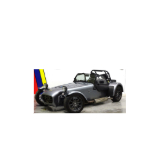
i've got a CG lock in the drivers seat and notice ahuge difference to the normal seatbelt - cant comment on harnesses tho!dezzy wrote:I'm definitely going to get CG locks for when I start tracking the car, in advance of considering harnesses. I felt a big difference with the CG locks in Andy's and Ed's cars, compared to when I went out with people who didn't have them and I just had a standard seatbelt. My fat ass was sliding all over the place!
Caterham Roadsport 190
Tesla Model 3 LR RWD
Volvo XC60 - family and dug spec!
Tesla Model 3 LR RWD
Volvo XC60 - family and dug spec!

I love my harnesses, but the pax one is annoying as my pax (Unlkes sit's the g/f can't normally cope....
I personally would not have a problem with the increased lever arm debate, afterall the seat is glass fiber and that is all the seatbelt seems to mount into...
PS Check your seat mount points! Mine were loose (Again!) even after being threadlocked last time (6 months ago)
I personally would not have a problem with the increased lever arm debate, afterall the seat is glass fiber and that is all the seatbelt seems to mount into...
PS Check your seat mount points! Mine were loose (Again!) even after being threadlocked last time (6 months ago)
1994 Lotus Esprit S4 - Work in progress
1980 Porsche 924 Turbo - Funky Interior Spec
2004 Smart Roadster Coupe - Hers
1980 Porsche 924 Turbo - Funky Interior Spec
2004 Smart Roadster Coupe - Hers

Interesting debate here on the likely effect of harnesses. I do a lot of RTA work, and a lot of that has significant emphasis on the interraction of seatbelts (or more properly, lack of them) and the injuries sustained. Are you saying the wrist injury would've been prevented by the harness (I doubt it) or the back injury? All depends on the type of fracture (wedge, compression etc) and the 'mechanics' of the injury. IMHO, harnesses would likely prevent an injury further up the spine (e.g. thoracic or cervical, your C- or T- prefixes) given the upper body is held closer to the seat. With a lumbar injury (correct me if I'm wrong here Novice!) its likely to be a low impact, e.g. getting rear-ended or the car coming off the road with a thump. The restraining part of an inertia reel is more or less the same (IIRC) as the harnesses over the pelvic area so doubtful if they would have made a difference with the L-spine injury.Blaque wrote:To be fair, I have previous compression fractures to L2 and L3 from hitting a pickup truck 18 years ago. And now a fracture to L1, this may be just a weak area for me.
I can see the problems with harnesses, but for me it's that snap back into the seat in a collision that damages the back, and done up properly this would prevent it. Maybe CG Locks are what I should be looking at?
All IMHO of course

Ferrari 458
Porsche 993 C2
Disco V
Porsche 993 C2
Disco V

There are no external forces pushing you back into the seat at the end of an accident (or any other time, except for the tiny acceleration force from the engine). [OK, I'm going to retract that, a bit, if the car is spinning then there will be some centripetal force from the seat into your back, but that would be while it was spinning and wouldn't reverse when you come to a stop; what I wrote originally is true if your car isn't spinning, though].Blaque wrote:I can see the problems with harnesses, but for me it's that snap back into the seat in a collision that damages the back, and done up properly this would prevent it. Maybe CG Locks are what I should be looking at?
I can only assume that the snap back into the seat happens because of elasticity in your spine (and the muscles that you clench when you want to stop yourself going forward). When your body comes to a rest suddenly you cannot stop clenching quick enough and you slam yourself back into the seat.
The reason you cannot stop yourself travelling forward is not really the give in the belts (travel while the inertia lock catches, stretch in the actual belt, movement in the anchoring points) but rather the mass of your head bending your body forward.
With lap belts, the whole spine can bend from the base all the way to the shoulders, so the effort is "shared".
With harnesses (assuming they're fitted properly), your shoulders will remain pinned to the seat and it's only your neck that will bend - so much so that you can disconnect it from the base of your skull!.
So you add a HANS device to limit the travel of your skull as well. At that point your brain tries to escape out of your nose, because nothing is stopping it, even though your skeleton is held tight
So I think it's horses for courses - for road driving at road legal-ish speeds, a 3-point belt probably offers best all round protection, though will in some cases leave you with more injuries than a multi-point harness, it generally won't leave you dead
Cheers,
Robin
Last edited by robin on Wed Nov 22, 2006 2:39 pm, edited 1 time in total.
Yep! and the left shoulder has more freedom to move forward, and so more momentum. That's why I was thinking harnesssimon wrote:I assumed the wrist would have been caused by holding on to the steering wheel during impact. There's a reason you often see racing drivers let go of the wheel!GregR wrote:Are you saying the wrist injury would've been prevented by the harness (I doubt it) or the back injury?

 to the doc who did it.